
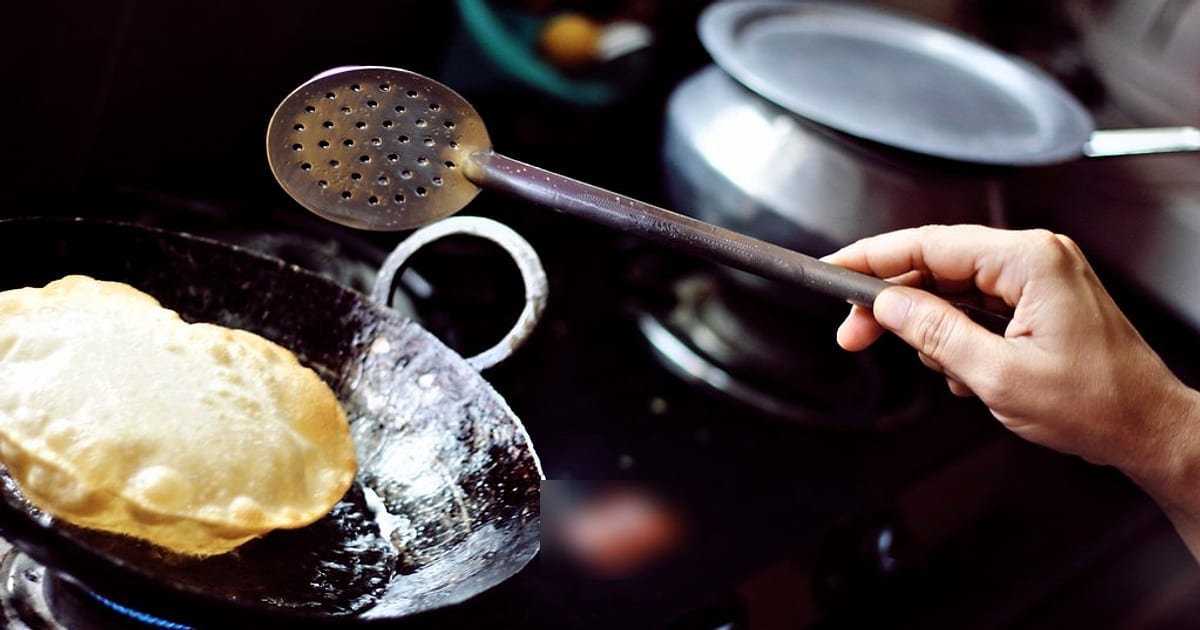
Anyone who has fried a batch of pakoras knows the sad moment. The first few go in beautifully, then the oil goes quiet, the pakoras turn pale and heavy, and you stand there waiting. A heavy cast iron kadai helps with exactly this problem. The thick iron stores a lot of heat, so the oil recovers faster after cold batter or dough goes in, and crisp food is far more likely. This article explains why, in plain words, and how to use it.
The moment the oil cools down
Think about what happens when you drop a puri into hot oil. The oil is around 180 degrees. The dough is at room temperature, or even colder if it came from the fridge. Heat rushes from the oil into the dough, and the oil near it gets cooler within seconds.
Now the food has two jobs. It must dry out on the surface and form a crust, and it must cook through inside. That needs the oil to stay hot. If the oil drops too far, the crust forms slowly, and the food sits in warm oil soaking it up instead of sealing itself.
The trick is to make that dip as small and as short as possible. Three things control it:
- How much food goes in at once. More food means more cold to heat up.
- How strong your flame or hob is. This decides how fast heat comes back in.
- How much heat the kadai and oil already hold. This is where heavy iron helps.
Why heavy iron keeps oil hot
Every material needs some amount of heat to rise by one degree. Scientists call this its heat capacity. A thick, heavy kadai has a large heat capacity, because it simply has a lot of metal in it.
Here is a rough picture, using figures from standard engineering tables. Cast iron has a specific heat of about 0.46 kilojoules per kilogram per degree. Vegetable oil is around 1.7 to 2 on the same scale, depending on the oil. So a kilo of oil holds several times more heat than a kilo of iron. But a 27 cm RIVEDA kadai weighs 2.7 kg, and the oil for a small frying session may be only a litre or so. Working it out roughly, the iron body of that kadai holds heat in the same range as the oil sitting in it. These are rough sums for understanding, not a test of any particular pan.
What does this mean in the kitchen? When cold batter goes in and the oil gives up some heat, the hot iron around it gives heat back into the oil straight away. The dip is shallower, and the oil returns to temperature sooner. A thin pan has little stored heat to give. It depends almost entirely on the flame to recover, and that takes longer.
Think of a water tank. A big tank on the roof keeps supplying water even when every tap is open. A small bucket runs dry quickly. A heavy kadai is the bigger tank of heat.
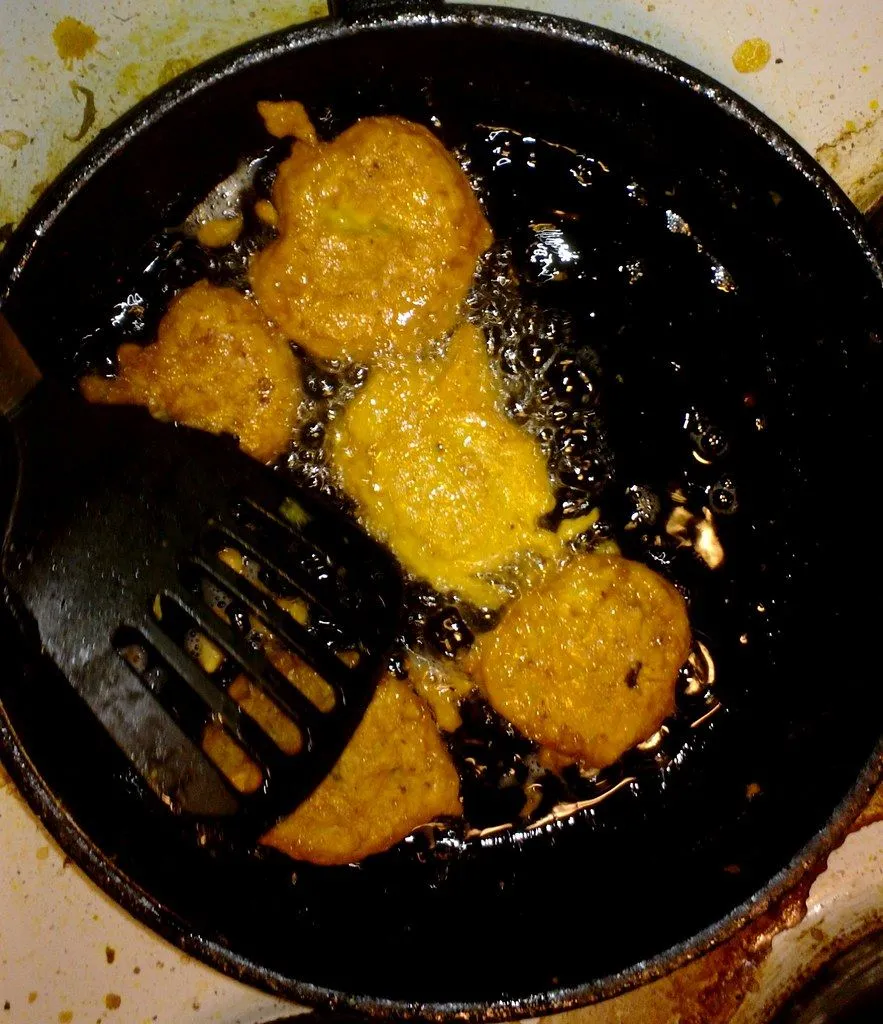 Pakoras frying in hot oil in a black pan. The steady bubbling means moisture is leaving the batter and the crust is forming. Photo: Debarshi Ray, CC BY-SA 2.0.
An honest limit
Heavy iron is a help, not a miracle. The oil itself carries a good share of the heat, and only the part of the kadai in contact with the oil gives heat quickly. The handles and the outside rim do not help much. Food writers’ pan tests also disagree about how long a filled pot stays warm after the flame is off, so we do not claim cast iron beats every other metal at everything. What is solid is the plain physics above: more iron near the oil means a bigger store of heat to draw on when cold food arrives.
Heavy iron also takes longer to heat up at the start. That is the price of the extra stored heat. Plan for it, as the next section shows.
What crisp actually means
Deep frying is normally done with oil somewhere between about 175 and 190 degrees, according to food science references.
When food enters oil in that range, the water on its surface turns to steam very quickly. You see this as the lively bubbling and sizzle. The surface dries out, then browns and turns into a firm crust. This browning comes from reactions between sugars and proteins in the food, and it gives the golden colour and the cooked flavour.
That crust matters. Research on frying describes it as a barrier that limits how much oil gets in. A 2025 study in Nature Communications, which used high-speed X-ray imaging to watch oil enter fried food, found that most of the oil uptake happens during cooling after the food leaves the fryer, not while it is in the oil. A review in the International Journal of Food Science and Technology explains why. As steam inside the crust condenses and the pressure drops, oil can be sucked into the pores.
So there are two lessons for home cooks:
- Build a strong crust while the food is in the oil. That needs the oil to stay properly hot.
- Lift the food out and let the extra oil drain at once. Put pakoras on a wire rack or a paper towel instead of stacking them in a closed box, where steam softens the crust.
If the oil is too cool, the crust forms slowly and the food can end up greasy. Sources differ on the exact numbers, so the practical test below matters more than any one figure.
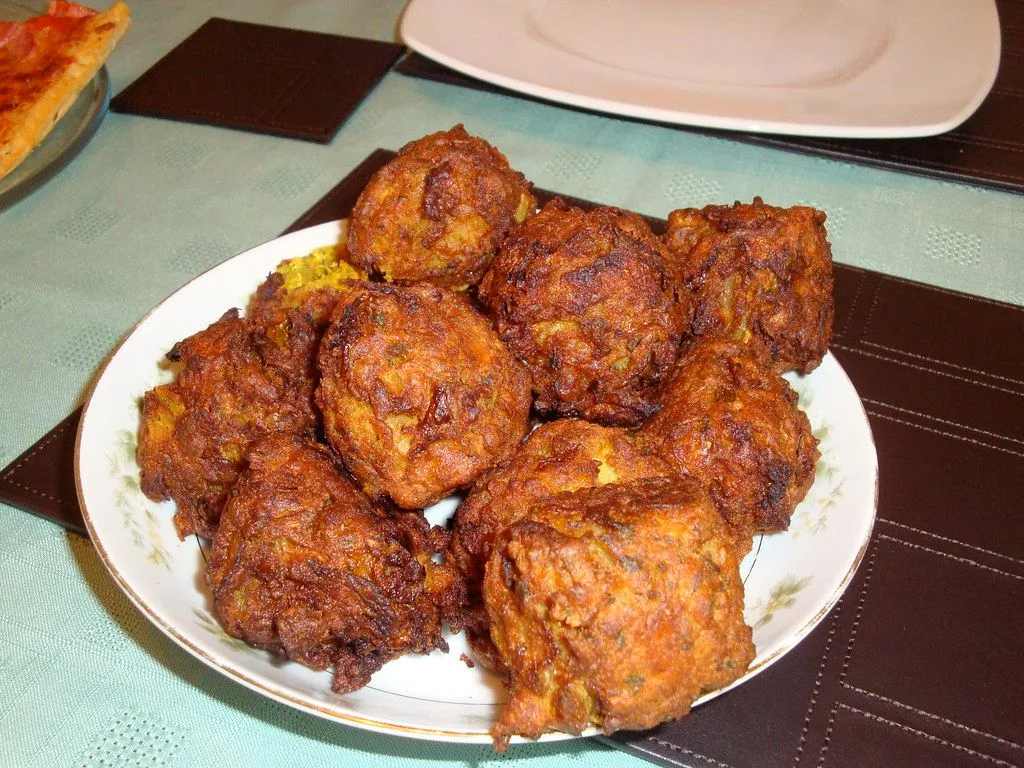 Onion bhajis with a deep golden, crisp crust. This is the finish you are aiming for. Photo: mdid, CC BY 2.0.
Pakoras, puris and bhajiyas: what to expect
Different foods stress the oil in different ways. Here is a quick guide.
| Food | What cold thing goes in | How to help the oil recover |
|---|---|---|
| Pakoras, bhajiyas | Wet batter with vegetables | Fry a few at a time, keep them apart |
| Puris | Rolled dough, one by one | Fry one or two at a time; keep the flame steady |
| Kachori, samosa | Thick, filled dough | Start on a slightly lower heat so the inside cooks |
| Frozen or fridge-cold snacks | Very cold food | Bring to room temperature first if you can |
Pakoras and bhajiyas. A thick batter holds together and fries crisp. A drop of batter in the oil should sizzle and rise to the top steadily, without turning dark at once. If it floats up immediately and browns, the oil is too hot. If it sinks and lies there, the oil is not ready.
Puris. A puri puffs when its surface seals quickly and the steam inside inflates it. Recipe writers commonly suggest a small piece of dough should rise to the surface within a couple of seconds. If puris stay flat, the oil is often too cool, though dough that is too soft or rolled unevenly can also be the reason.
Kachori and samosa. These have thick dough and fillings, so they need time. Fry them on a medium flame so the outside does not brown before the inside cooks.
How to use your kadai for the best results
Heavy iron rewards a little patience. Follow these steps.
- Dry the kadai fully. Any water left in the kadai will spit when oil goes in. Wipe it dry or warm it for a minute.
- Add the oil and heat slowly. Start on a medium flame and give the iron time to warm through. Heating slowly lets the whole kadai fill up with heat, and that stored heat is what you will use later.
- Fill the kadai sensibly. Fill the kadai only about one-third, never more than half, so the oil stays well below the rim. Hot oil rises and bubbles when food goes in.
- Test the oil. Use a pinch of batter or a scrap of dough as described above. A frying thermometer is a good tool if you have one.
- Pat wet food dry. Water drops make hot oil spit. Dry paneer, potatoes or sliced vegetables with a cloth before they go in.
- Slide food in, do not drop it. Lower it in beside you, away from your body.
- Fry in small batches. Fry one layer, with space around each piece. Let the oil bubble steadily again before the next batch.
- Adjust the flame in small steps. Because iron holds heat, it also keeps it. If the oil gets too hot, turn the flame down and wait a minute rather than adding cold oil.
- Drain on a rack. Do not stack hot fried food on top of each other.
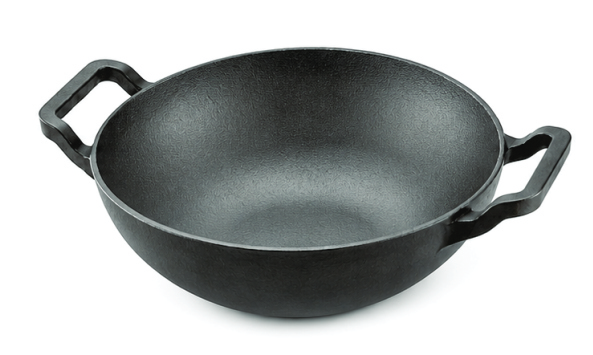
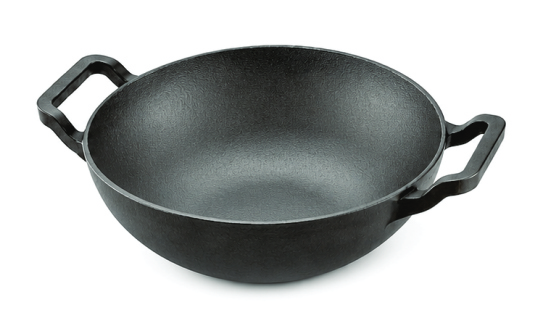
If you are comparing sizes, the Cast Iron Kadai 27 CM is the everyday family size, and the Cast Iron Kadai 31 CM gives more room for festival batches. Our guide on how to choose the best cast iron kadai goes through depth, handles and weight in more detail.
Frying on gas and on induction
Cast iron works on both. On a gas stove, the flame should stay under the base of the kadai. A flame that licks up the sides only heats the handles and wastes gas. Use a stable ring or stand so the kadai does not rock when you stir.
On an induction hob, cast iron is magnetic, so it heats well. A cast iron kadai has a heavy body and a curved base, so check how steadily it sits on the glass, and follow your hob maker’s guidance on base size and weight. Raise the power in steps. Induction can heat oil fast, and it is easy to overshoot. Our article on cast iron on induction covers this in detail.
On any stove, stay with the pan. Heavy iron keeps oil hot for longer after you switch off, so do not walk away just because the flame is off.
Oil safety in plain words
Hot oil is the most dangerous thing in many kitchens. A few rules keep you safe.
- Water and hot oil do not mix. The US Department of Agriculture’s food safety service explains that when water meets very hot oil it turns to steam instantly, and the steam expands fast and can throw oil out of the pan. Dry your food and your utensils.
- Never leave hot oil alone. Fire safety agencies list this among the main cooking safety rules.
- Keep a fire extinguisher nearby. Michigan State University Extension advises this for deep fat fryers. Never pour water on an oil fire. Switch off the heat and cover the pan with a lid if you can do so safely.
- Watch for smoke. If the oil starts to smoke, it is too hot. Take it off the heat.
- Keep children and pets away. Cast iron handles get hot too, so use a dry cloth or silicon handle sleeves.
What to do with used oil
Oil changes every time you heat it. FSSAI, India’s food regulator, sets a limit on the Total Polar Compounds in frying oil used by food businesses: oil above 25 per cent should not be used for frying, and it cannot be fixed by adding fresh oil. Home cooks cannot measure this, so the sensible habit is to use as little reused oil as possible. Throw away oil that is dark, foamy, smoky or has an off smell. Straining it after use removes burnt bits that would spoil it faster.
One honest note: the US food-safety agency USDA FSIS, in its Deep Fat Frying and Food Safety page, advises against cast iron for deep frying because it can break oil down faster than other metals. So use fresh oil, do not overheat it, strain it after use, and do not reuse it many times.
Caring for your kadai after frying
Deep frying is kind to cast iron. Oil coats the surface, and the heat helps the seasoning grow. A kadai used for pakoras every week is usually a happy kadai.
After cooking, let the oil cool well before you move the kadai. Pour it through a strainer into a jar. Wipe out the kadai, then wash with hot water and a brush while it is still warm. Dry it fully, put it on a low flame for a minute or two, and rub on a very thin film of oil. Wipe off most of it, so the kadai looks barely oiled, not wet.
Do not soak the kadai or leave it wet overnight, especially in the monsoon. If rust appears, our guide to removing rust from cast iron shows how. The care page and the seasoning page cover the everyday routine.
Every RIVEDA piece arrives pre-seasoned, so you can start cooking right away. What pre-seasoned means explains what that layer is and how it grows. For the wider picture, see is cast iron cooking healthy.
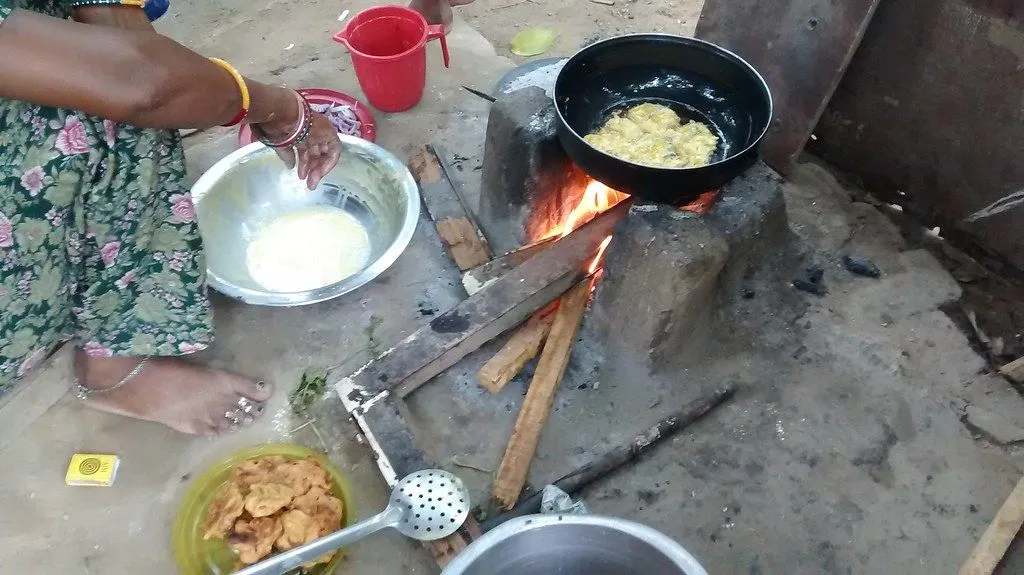 Pakoras frying in a wide black pan over a wood fire. Frying in an open pan like this is an old, everyday way of cooking in India. Photo: CS Sharada Prasad, CC BY 2.0.
A simple Sunday test
Want to see it yourself? Try this next time you fry.
- Heat the oil slowly in your cast iron kadai until a drop of batter rises steadily and sizzles.
- Fry one small batch of pakoras, with space around each.
- Watch how quickly the bubbling comes back after you add them.
- Next, crowd the kadai with twice as many and see what happens.
Small batches stay crisp, and heavy iron gives you more room for error when you are cooking for a crowd.
The short answer
A cast iron kadai helps with deep frying because the thick iron stores heat and gives it back to the oil when cold food goes in. That keeps the dip smaller, helps the crust form fast, and gives crisper pakoras and puffed puris. Still, small batches, dry food, a steady flame and a watchful eye matter just as much. Take your time heating the oil, test it with a pinch of batter, and enjoy the crunch.
Ready to choose? Browse the kadai range, or see our cooking guide for what else a kadai can do. For questions, our FAQ page has answers, and you can message us on WhatsApp at +91 90999 29629. Both RIVEDA kadai are cast in sand and finished at our own ZED-certified foundry in Rajkot, and they ship across India from Rajkot. If a piece arrives damaged or wrong, you can return it within 7 days of delivery.
Shop this article
Frequently asked questions
Which size kadai is best for deep frying at home?
A 27 cm kadai suits most families for puris, pakoras and bhajiyas, because it is deep enough to keep oil from spilling and wide enough to fry a few pieces at a time. Choose a 31 cm kadai for festival batches or if you cook for many people. Either way, keep the oil well below the rim.
How much oil should I put in a cast iron kadai for deep frying?
Enough for the food to float and move freely. Fill the kadai only about one-third, and never more than half. Hot oil rises and bubbles when food goes in, so leave plenty of space below the rim.
Can I deep fry in a cast iron kadai on an induction cooktop?
Yes, cast iron is magnetic and works on induction. Follow your hob maker's guidance on base size and weight, set the heat in steps, and stay with the pan, because oil can overheat quickly.
How do I know the oil is hot enough without a thermometer?
Drop in a pinch of batter or a small piece of dough. For pakoras it should sizzle and rise to the top steadily without turning brown at once. For puris, a small dough piece should come up within a couple of seconds. Adjust the flame and test again.
Can I reuse the frying oil from my kadai?
FSSAI sets a limit for used frying oil in food businesses, and as a home cook the safe habit is to reuse as little as possible. Throw away oil that is dark, foamy, smoky or smells off, and never top up very old oil with fresh oil.
Do I need to season the kadai again after frying?
Deep frying actually helps the seasoning. Let the oil cool, strain it, wipe or wash the kadai, dry it fully on a low flame and rub in a very thin film of oil. Our care page has the full routine.
Sources
- Deep Fat Frying and Food Safety — USDA Food Safety and Inspection Service
- Deep Fat Frying (overview of the process and typical oil temperatures) — ScienceDirect Topics
- High-speed computed tomography to visualise the 3D microstructural dynamics of oil uptake in deep-fried foods — Nature Communications, 2025
- Review of mechanisms, conditions, and factors involved in the oil uptake phenomenon during the deep-fat frying process — International Journal of Food Science and Technology
- Metals - Specific Heats — The Engineering ToolBox
- Specific Heat of Common Liquids and Fluids — The Engineering ToolBox
- Staying warm: Cast iron vs. stainless steel — Khymos (food chemistry blog by Martin Lersch)
- FoodSmart: Reusing cooking oil and the 25% Total Polar Compounds limit — FSSAI (Food Safety and Standards Authority of India)
- Cooking safety — Indiana Department of Homeland Security
- Deep fat fryer safety — Michigan State University Extension
More on this topic: all kadai articles →
Pictures: cast-iron-kadai-for-deep-frying.jpg (cover) — Mahin Fayaz, CC BY 2.0; pakoras-in-hot-oil.jpg — Debarshi Ray, CC BY-SA 2.0; pakoras-on-wood-fire.jpg — CS Sharada Prasad, CC BY 2.0; onion-bhajis-plate.jpg — mdid, CC BY 2.0.
Follow the RIVEDA blog
One short email a week with new articles — cast iron cooking, care and recipes for Indian kitchens. No spam; unsubscribe in one click.